THE NEW WHITE BREAST LURE HAS THE BLUES
Colors and Shimmer , do they make a difference.
By Trista Penoyer
Yes—metallic blue can be valuable, but probably for a different reason than red. Bass likely respond more to its flash, darkness and contrast than to “blue” as a distinct color.
Research shows largemouth bass have two main daytime color channels: one most sensitive to green and another to red. They distinguish red particularly well, while blues can look closer to green, gray or black depending on lighting. University of Illinois bass-vision study.
How Bird Colors Attract Bass
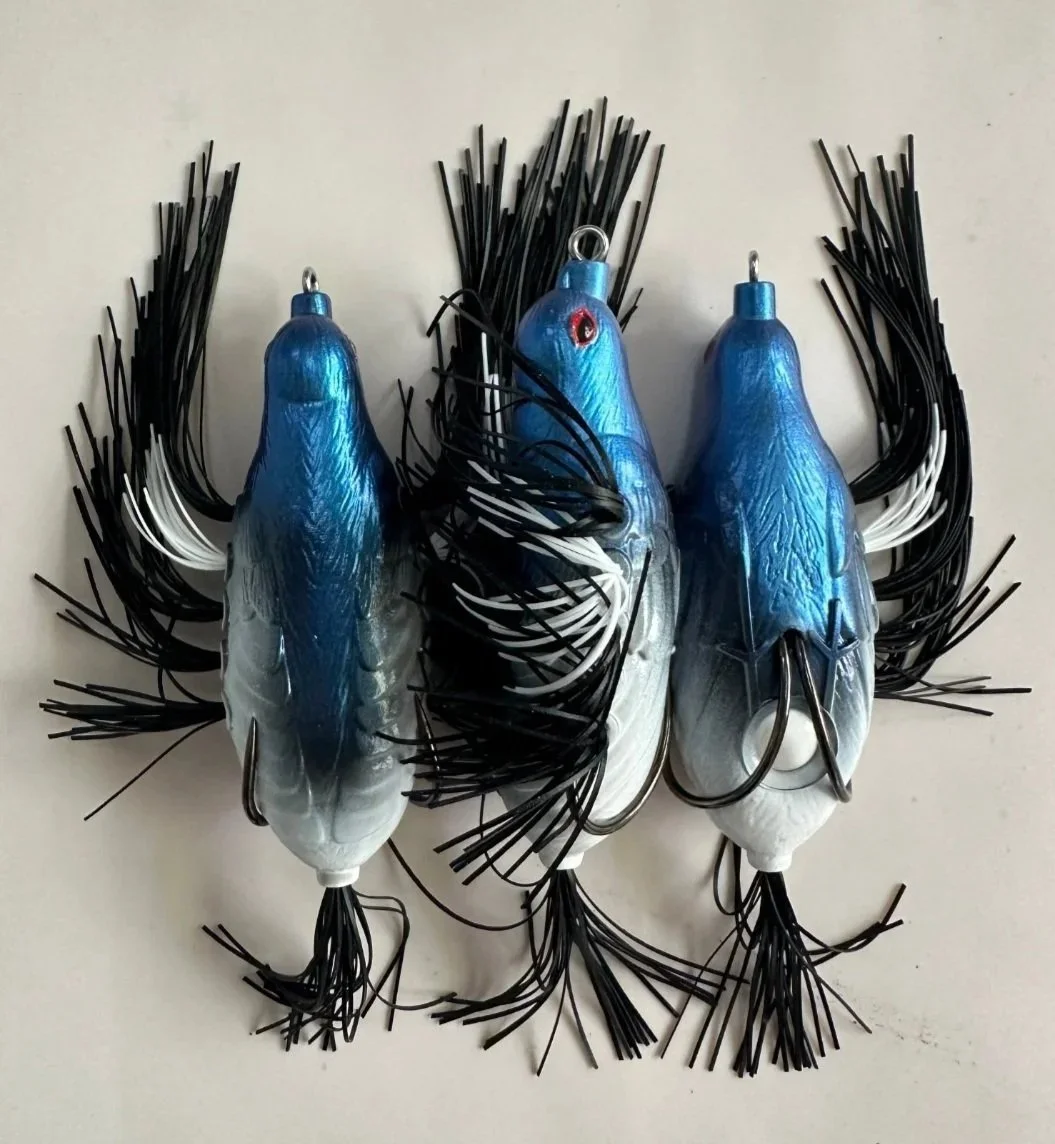
Metallic Blue
Metallic blue offers three important benefits:
It changes brightness as the wings move, creating a flickering flash.
From below, portions of it may appear dark against the bright surface, strengthening the lure’s silhouette.
Blue-green metallic finishes resemble the iridescence found on tree swallows, blue jays, and other birds while also producing baitfish-like flashes.
Because the lure remains on the surface, blue light has not been significantly filtered by depth. This gives metallic blue its best opportunity to flash. I would use it on the back and upper wings, bordered with black or dark charcoal. A white or pearl belly would create a strong light-to-dark transition as the lure rocks across the surface.
Red
Red is especially interesting for Flip In The Bird. Bass possess red-sensitive cone cells and can distinguish red from gray and other colors particularly well under adequate lighting conditions. Their red-sensitive receptors peak at approximately 614 nanometers, according to published spectral findings.
Red works best:
On or near the surface
In very shallow water
During daylight
As a concentrated target rather than across the entire lure
Next to black, white, or green for contrast
As red light is absorbed underwater, red progressively appears darker. This matters less for a floating lure than it does for a deep-diving bait. Even when red loses some of its brilliance, it can still create a dark target and contribute to the lure’s overall silhouette.
The Best Approach for Flip In The Bird
The design should not depend on bass recognizing a specific bird species. There is little evidence that bass identify a blue jay versus a red-winged blackbird based on color alone. The most effective triggers are more likely to be:
A strong surface silhouette
Wing movement
Flickering flashes
Strong boundaries between colors
Prey-like vulnerability
A concentrated strike target
The strongest metallic-blue design would be:
Metallic-blue back and wings, a black outline, a pearl-white belly, and a small red throat or breast accent.
This combination provides metallic flash, a natural bird-inspired pattern, strong underside contrast, and a concentrated red strike point.
The Red-Winged Blackbird pattern is also scientifically sensible. Its black body creates a strong silhouette, while the concentrated red shoulder patch provides a highly visible accent without overpowering the rest of the pattern.